Saturday, March 19, 2011

Clinton, Rice joined to get buy-in for no-fly

From Elise Labott,
CNN Senior State Department Producer
March 20, 2011 -- Updated 0321 GMT (1121 HKT)


Washington (CNN) -- President Barack Obama's decision to undertake military action in Libya to enforce a no-fly zone was the product of an administration debate with unlikely bedfellows.

Initially, Secretary of State Hillary Clinton was skeptical of the U.S. joining a military coalition.
Initially, Secretary of State Hillary Clinton was skeptical of the U.S. joining a military coalition. But senior U.S. officials said advances last weekend made by forces loyal to Gadhafi in retaking rebel strongholds in the east, which opened up the possibility of thousands more being killed, convinced her action was necessary.

Additionally, a statement by the Arab League calling for the United Nations to enforce a no-fly zone, Clinton told reporters Saturday, "changed the diplomatic landscape."

As Britain and France pushed for a quick U.N. Security Council resolution authorizing a no-fly zone, officials said Clinton teamed up with Susan Rice, U.S. ambassador to the United Nations, in creating the conditions for a resolution with the broadest possible authority and the largest international support.

STORY HIGHLIGHTS

  • Defense secretary, vice president opposed U.S. action

  • Arab League statement "changed the landscape"

  • Secretary of state pressed UAE for support
  • Clinton made the case that U.S. support for a no-fly zone was conditioned on Arab participation and leadership. In Paris, Clinton met with her counterparts in town for a meeting of the Group of 8 foreign ministers and with Abdullah bin Zayed, the foreign minister of the United Arab Emirates. Even as she criticized the UAE for its recent decision to send forces to quell a rebellion in Bahrain, Clinton pressed him to send planes to Libya.

    As Clinton traveled to Cairo and Tunisia seeking Arab buy-in for the resolution, officials said Rice built support in New York for the resolution. Samantha Power, an adviser to Obama on the National Security Council and a human rights activist, was also urging the president to intervene.

    Clinton's alliance with Rice and Power in pushing for intervention put her at odds with Defense Secretary Robert Gates, who had publicly argued against a no-fly zone. Sources said Vice President Joe Biden was also more cautious, arguing for the smallest possible U.S. involvement in any military action.

    A senior administration official said that "like the president, the vice president wanted any action taken with a broad international coalition." The official, who spoke on the condition of anonymity to discuss sensitive military planning, said when the vice president "saw that was achievable, he supported the policy to seek the military intervention."

    After meeting with Amr Moussa, secretary general of the Arab League, in Cairo Tuesday night, officials said Clinton called Obama, telling him the Arabs were willing to take part in the no-fly zone. That participation, officials said, was critical for the administration, which was concerned about the perception of invading a third Arab country.

    "In order for us to go along, it was important for the Arabs to have some skin in the game," one senior official said.

    CNN Senior White House Correspondent Ed Henry contributed to this report.


    Gunfire, explosions heard in Tripoli


    U.S., British and French forces launched attacks on Moammar Gadhafi's forces on Saturday
    after the Libyan leader refused to stop attacking Libyan civilians in the North African country's civil war.

    By the CNN Wire Staff
    March 20, 2011
    Updated 0310 GMT (1110 HKT)

    Tripoli, Libya (CNN) -- Explosions and anti-aircraft fire thundered in the skies above Tripoli early Sunday, but it was not clear whether they resulted from another round of cruise missile attacks by allies determined to stop Moammar Gadhafi's offensive against Libyan opposition forces.

    STORY HIGHLIGHTS

  • British jets flew 3,000 miles to bomb targets

  • Explosions, gunfire heard overnight in Tripoli

  • Gadhafi supporters rally in Tripoli

  • Gadhafi vows to counter "naked aggression"
  • CNN's Nic Robertson witnessed the development a few hours after nearly 1,000 people gathered at Gadhafi's palace in the capital. The crowd chanted, waved flags and shot off fireworks in support of the government.

    A defiant Gadhafi said Libya will fight back against undeserved "naked aggression." His military claimed nearly 50 people, including, women, children and clerics, were killed in Saturday evening's attacks. There was no independent confirmation of that statement.

    American, French and British military forces, convinced that Gadhafi was not adhering to a United Nations-mandated cease-fire, hammered Libyan military positions with missiles and fighter jets in the first phase of an operation that will include enforcement of a no-fly zone.

    An eyewitness in Tripoli reported seeing signs of gunfire rising Sunday morning from the direction of nearby Mitiga Airport. The anti-Gadhafi activist said she heard "continuous gunshots" and at least two loud explosions. It was not clear if the airport was also being used as a military installation.

    The eyewitness, who was not identified for security reasons, said she did not hear the sound of flying aircraft.

    More than 110 Tomahawk missiles fired from American and British ships and submarines hit about 20 Libyan air and missile defense targets in western portions of the country, U.S. Vice Adm. William Gortney said at a Pentagon briefing.

    The U.S. will conduct a damage assessment of the sites, which include SA-5 missiles and communications facilities. A senior U.S. military official, who was not authorized to speak on the record, said the cruise missiles, which fly close to the ground or sea at about 550 miles per hour, landed near Misrata and Tripoli.

    The salvo, in an operation dubbed "Odyssey Dawn," was meant "to deny the Libyan regime from using force against its own people," said Gortney.

    U.S. Navy photos showed flashes of light and smoke funnels as missiles soared from a destroyer into the night sky.

    Earlier, French fighter jets deployed over Libya fired at a military vehicle Saturday, the first strike against Gadhafi's military forces, which earlier attacked the rebel stronghold of Benghazi.

    Prime Minister David Cameron said late Saturday that British forces also are in action over Libya. "What we are doing is necessary, it is legal and it is right," he said. "I believe we should not stand aside while this dictator murders his own people."

    British Defense Secretary Liam Fox said the Royal Air Force deployed Tornado GR4 fast jets, which flew 3,000 miles from the United Kingdom and back, "making this the longest-range bombing mission conducted by the RAF since the (1982) Falklands conflict."

    While there were no U.S. warplanes flying over Libya late Saturday, the coalition was softening Libyan positions before enforcing a no-fly zone, Gortney said.

    The Libyan military, in a statement broadcast on state TV, said, "An enemy attacked the state on March 19th with rockets ... Those enemies killed 48 martyrs -- mostly women, children, and religious clerics. They left more than 150 injured. The majority of these attacks were on public areas, hospitals and schools. They frightened the children and women near those areas that were subject to this aggression."

    Gadhafi, speaking early Sunday on Libyan state TV, said the U.N. charter provides for Libya's right to defend itself in a "war zone." Weapons depots will be opened, he said.

    "All you people of the Islamic nations and Africa, and Latin America and Asia, stand with the Libyan people in its fight against this aggression," Gadhafi said.

    Air attacks on several locations in Tripoli and Misrata have caused "real harm" to civilians, a Libyan government spokesman said.

    An eyewitness in Misrata said Gadhafi's forces are targeting fuel and power stations in an effort to make citizens believe the damage is being done by coalition forces. The eyewitness, who was not identified for security reasons, said people celebrated allied airstrikes on loyalist positions in the city. CNN could not verify the account.

    Shortly after the first missile attacks, U.S. President Barack Obama informed the American people of the efforts by a "broad coalition."

    "The use of force is not our first choice," the president said from Brasilia, Brazil. "It is not a choice I make lightly. But we cannot stand idly by when a tyrant tells his own people that there will be no mercy."

    Obama is planning for the U.S. portion of the military action in Libya to only last for a few days, according to a senior administration official, who was not authorized to speak about sensitive military matters.

    "After that we'll take more of a supporting role," the senior official said.

    Obama authorized U.S. military force from Brazil on what happened to be the eighth anniversary of the start of the war in Iraq.

    Coalition partners say Gadhafi has failed to adhere to a United Nations resolution that imposed the no-fly zone and ordered him to stop attacks on civilians.

    "He's clearly been on the offensive," the senior U.S. military official said of Gadhafi. "He said that he was going to do a cease-fire and he continued to move his forces into Benghazi."

    Earlier Saturday, Gadhafi issued defiant messages to international powers.

    "I have all the Libyan people with me and I'm prepared to die. And they are prepared to die for me. Men, women and even children," Gadhafi said in a letter addressed to Obama and read to reporters by a government spokesman in Tripoli.

    Obama, Secretary of State Hillary Clinton and Gortney used the term "unique capabilities" to describe the U.S. part of the effort. Officials have said American military forces are meant to augment Arab, European and other Western troops.

    In the next few days, U.S. military officials expect to hand over control to a coalition commander. Canada and Italy also are part of the coalition.

    "Our air force will oppose any aggression by Colonel Gadhafi against the population of Benghazi," said French President Nicolas Sarkozy, speaking after a top-level meeting in Paris over the Libyan crisis.

    The international meeting -- which included Western and Arab partners -- focused on how to take on a Libyan government bent on destroying the fledgling opposition movement under the U.N. resolution authorizing force to protect civilians against the Gadhafi government.

    Rebel forces in Benghazi used a captured army tank as a victory symbol, CNN's Arwa Damon reported.

    Earlier Saturday, incoming artillery rounds landed inside Benghazi, and pro-Gadhafi tanks rolled into the town firing rounds, witnesses said.

    A flaming fighter jet plummeted from the sky, nose-diving to the ground. Khaled el-Sayeh, the opposition military spokesman, said the plane was an old MiG-23 that belonged to the rebels.

    As night fell over Benghazi on Saturday, the city became quiet and calm. While plumes of smoke could be spotted, the pro-Gadhafi tanks seen earlier were not in sight. El-Sayeh told CNN that "tens" had been killed in Benghazi on Saturday.

    He said Gadhafi forces had withdrawn from the city and that they were positioned 50 kilometers (31 miles) outside Benghazi. CNN could not independently verify those details.

    Gadhafi -- in a separate letter addressed to Sarkozy, Cameron and U.N. Secretary-General Ban Ki-moon -- called the U.N. moves "invalid" because the resolution does not permit intervention in the internal affairs of other countries.

    Violence has raged in Libya following protests calling for democracy and freedom and demanding an end to Gadhafi's almost 42-year-long rule. It's a conflict spurred by anti-government protest and resulting regime violence against civilians -- which the U.N. resolution cites as "outrageous" and Sarkozy calls "murderous madness."

    CNN's Arwa Damon, Chris Lawrence, Jill Dougherty, Elise Labott, Ed Henry, Jim Bittermann, Paula Newton, Richard Roth and Nic Robertson contributed to this report


    Did Britain try to assassinate Lenin?

    By Mike Thomson
    Presenter, Document, Radio 4

    Lenin survived an assassination attempt in 1918 although he was badly wounded
    Nearly a century ago, Britain was accused of masterminding a failed plot to kill Lenin and overthrow his fledgling Bolshevik regime. The British government dismissed the story as mere Soviet propaganda - but new evidence suggests it might be true.

    For decades what became known as the "Lockhart plot" has been etched in the annals of the Soviet archives, taught in schools and even illustrated in films.

    In early 1918, in the final months of World War I, Russia's new Bolshevik government was negotiating a peace deal with Germany and withdrawing its exhausted troops from the front.

    This did not please London. The move would enable Berlin - which had been fighting a war on two fronts - to reinforce its forces in the West.

    Determined to get the Russians back into the war on the Allied side, the British despatched a young man in his 30s to be London's representative in Moscow.

    His name was Robert Bruce Lockhart.

    Supporting anti-Bolsheviks

    Lockhart, a Scot, was a colourful character. Known for his love of wine, women and sports, he also prided himself on his alleged ability to read five books at the same time.

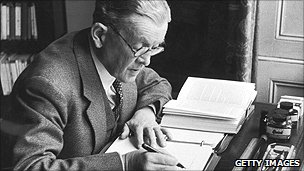
    Robert Bruce Lockhart in 1955
    At first, the well-read Lockhart seemed to be making progress on the issue but, in March that year, the Soviets signed the Brest-Litovsk peace treaty with Germany, so ending hope of them rejoining the war with the Allies.

    Lockhart, it seems, had no intention of giving up.

    Instead, the suggestion is, his attention was now turning to overthrowing the Bolshevik regime and replacing it with another government that would be willing to re-enter the war against Germany.

    Documents show that, in June, Lockhart asked London for money to fund various anti-Bolshevik organisations in Moscow.

    This letter, marked "urgent", was sent from the Foreign Office to the Treasury. It sums up the Foreign Secretary's attitude to the Moscow's representative's request:

    "Mr. Balfour is of the opinion that the moment has arrived when it has become necessary to take this action, and I am to request that you will move the Lords Committee to give the necessary sanction for the expenditure of such funds as Mr. Lockhart can collect for this purpose."

    Counter-revolution

    Timeline

  • 1914 outbreak of World War I between the Allies (France, Russia, Great Britain) and the Central Powers (Germany, Austria-Hungary, Turkey)

  • 1917 A popular revolution led by the Bolsheviks leads to the abdication of the tsar and the overthrow of his government

  • 1918 WWI ends; Tsar Nicholas is killed; civil war breaks out in which Lenin's Red Army eventually defeats the White Russians (or anti-communists) who are aided by many foreign powers
  • In late May, the British decided to send a small military force to Archangel in northern Russia.

    The official line was that the troops were going to prevent thousands of tonnes of British military equipment, supplied to the Russians, from falling into German hands.

    However, documents from the day suggest that plans were later drawn up for these 5,000 British troops to join forces with 20,000 crack Latvian troops who were guarding the Kremlin but could, it was thought, be turned against the Bolsheviks.

    In the summer of 1918, Lockhart sent a telegram to London following a meeting with a local opponent of the Bolsheviks called Savinkov.

    It read: "Savinkov's proposals for counter-revolution. Plan is how, on Allied intervention, Bolshevik barons will be murdered and military dictatorship formed."

    Underneath that telegram is a note bearing the signed initials of Lord Curzon, who was then a member of the British War Cabinet.

    It says: "Savinkoff's methods are drastic, though if successful probably effective, but we cannot say or do anything until intervention has been definitely decided upon."

    'Ace of Spies'

    Meanwhile Lockhart had teamed up in Moscow with another highly colourful character.

    Sidney Reilly, a Russian who had earlier changed his name from Rosenbloom, was a flamboyant, high-rolling entrepreneur who had recently begun working for the British Secret Services.

    He became known as the Ace of Spies, made famous in books of derring-do, and was even credited as being the inspiration for Alexander Fleming's James Bond.

    But both were soon in for a shock.

    In the late summer of 1918, an attempt was made in Moscow to assassinate Lenin. He was shot twice from close range by a young Russian woman.

    The Bolshevik's secret police, the Cheka, arrested Bruce Lockhart a few hours later and he was taken to the Kremlin for questioning.

    Reilly escaped the Cheka's clutches on that occasion but was shot dead several years later after being lured back into Russia.

    According to Cheka records, Lockhart confessed to being part of a plot proposed by London to kill Lenin and overthrow the Bolshevik government. But in early October 1918, Britain's representative to Moscow was freed in an exchange for his Russian counterpart in London.

    'Economical with the truth'

    In his best selling book, Memoirs of a British Agent published in the 1930s, Lockhart insisted that he had played no part either in attempts to kill Lenin or overthrow the Bolshevik government.

    Instead, he insisted that the maverick "Ace of Spies" Sidney Reilly was the man behind plans for a coup.

    Lockhart added that he had little to do with Reilly who some claimed was out of control.

    However, a letter written by Lockhart's son, Robin, has been discovered in archives in America. It suggests that his father was being rather economical with the truth:

    "If the question of my father's relationship with Reilly still exercises anyone's mind in the F.O., it is clear from his book Memoirs of a British Agent that once intervention in Russia had been decided on in 1918, he gave his active support to the counter-revolutionary movement with which, of course, Reilly was actively working.

    "My father has himself made it clear to me that he worked much more closely with Reilly than he had publicly indicated…"

    Whitehall 'pretence'

    The man who found that letter, Professor Robert Service, believes the only way to be sure of the truth would be to gain access to the rest of the files from the day.

    But, more than 90 years later, the British government continues to keep many of them secret. All, in Robert Service's view, to maintain the myth that Lockhart-style plots have not - nor ever would be - countenanced by London.

    "Britain today has a policy for its intelligence services that is openly averse to subverting foreign governments or assassinating foreign political leaders," he says.

    "My guess is that the thinking in Whitehall is that the pretence ought to be that this has always been the case. That the British have always been clean.

    "The British haven't always been clean. They have been as dirty as anyone else."

    Document: The Lockhart Plot will be broadcast on Monday 21 March at 2000 GMT on BBC Radio 4 and will also be available on the BBC iPlayer


    Libya assault:: UN's calculated gamble

      British Operation Ellamy

    Latest: U.S., allies strike more than 20 targets in Libya

    By Caroline Wyatt
    Defence correspondent,
    BBC News


    French forces have already flown a mission over Libya

    Some of the earliest key targets in the UN-backed assault on Libya are likely to be Colonel Muammar Gaddafi's command and control capabilities, as well as his air defences, which could still pose a threat to foreign aircraft.

    British Prime Minister David Cameron has said that British forces are already in action in the Libya operation, which is codenamed Operation Ellamy in the UK (the Americans are calling it Odyssey Dawn).

    At their home bases in the UK, Tornado GR4 ground attack aircraft and Typhoons for the air-to-air attack role are well prepared for what is to come.

    British warships are already off the coast in Libya to ensure the arms embargo is respected.

    Submarines have also been deployed for this mission, while experts say they would expect special forces to be in Libya already, having prepared the ground and assessed targets - their role, to send back vital information to those preparing and conducting the strikes from the skies or the seas.

    The French have already bombed Libyan tanks and jeeps.
    Demoralising Gaddafi's forces

    The main British contribution to this coalition are fighter jets, Sentinel R1 and Nimrod R1 reconnaissance and surveillance aircraft (AWACs) to give vital information about what's happening on the ground, plus VC10 tanker planes for air-to-air-refuelling.

    As part of the broad coalition, the US is also helping to remove the threat from Libya's air defences with sea-launched missiles.

    However, commanders will face tough decisions on what to target in the coming hours and days, so accurate intelligence from the ground is essential.

    While the hi-tech jets provided by France, the UK, Denmark, Norway, Canada and others should be able to dominate the skies easily, the mission to protect Libya's civilians runs a host of risks - from the dangers faced by pilots involved in the bombing raids, to the danger of civilian casualties if something goes wrong, especially with Col Gaddafi's forces so close to Benghazi.

    For the allies in the air, it is a calculated gamble. The UN resolution is wide-ranging, giving the coalition leeway not just to disable Col Gaddafi's air defences but also target Libyan ground forces.

    The hope is that this international show of strength from the air will demoralise his forces rapidly, and encourage them to flee or defect.

    At the very least, his ground forces will need to be pushed back from Benghazi and other rebel areas, if civilians are to be protected from attack. The Libyan forces loyal to Col Gaddafi already have very stretched supply lines across the open desert, which will be vulnerable to attack.

    But while the coalition in the air has a huge array of resources, those taking part are all too aware that their enormous firepower must be used carefully to ensure they do not endanger the very people the allies are there to protect.
    ------
      Gunfire, explosions heard in Tripoli


    By the CNN Wire Staff
    March 20, 2011
    -- Updated 0213 GMT (1013 HKT


    Tripoli, Libya (CNN) -- Explosions and anti-aircraft fire thundered in the skies above Tripoli early Sunday, but it was not clear whether they resulted from another round of cruise missile attacks by allies determined to stop Moammar Gadhafi's offensive against Libyan opposition forces.

    CNN's Nic Robertson witnessed the development a few hours after nearly 1,000 people gathered at Gadhafi's palace in the capital. The crowd chanted, waved flags and shot off fireworks in support of the government.

    A defiant Gadhafi said Libya will fight back against undeserved "naked aggression." His military claimed nearly 50 people, including, women, children and clerics, were killed in Saturday evening's attacks.

    American, French and British military forces, convinced that Gadhafi was not adhering to a United Nations-mandated cease-fire, hammered Libyan military positions with missiles and fighter jets in the first phase of an operation that will include enforcement of a no-fly zone.