Ông Đồ  Vũ Đình Liên (? – 20/01/1996) Mỗi năm hoa đào nở Lại thấy ông đồ già Bầy mực tàu giấy đỏ Bên phố đông người qua. Bao nhiêu người thuê viết Tấm tắc ngợi khen tài "Hoa tay thảo những nét Như phượng múa rồng bay." Nhưng mỗi năm mổi vắng Người thuê viết nay đâu? Giấy đỏ buồn không thắm Mực đọng trong nghiên sầu. Ông đồ vẫn ngối đấy Qua đường không ai hay Lá vàng rơi trên giấy Ngoài trời mưa bụi bay. Năm nay đào lại nở Không thấy ông đồ xưa Những người muôn năm cũ Hồn ở đâu bây giờ? | Chúc Tết  Tú Xương/Trần Kế Xương (1870 – 1907) Lẳng lặng mà nghe nó chúc nhau: Chúc nhau trăm tuổi bạc đầu râu Phen này ông quyết đi buôn cối Thiên hạ bao nhiêu đứa giã trầu. Lẳng lặng mà nghe nó chúc giàu: Trăm, nghìn, vạn mớ để vào đâu? Phen này, ắt hẳn gà ăn bạc Đồng rụng, đồng rơi, lọ phải cầu. Lẳng lặng mà nghe nó chúc sang: Đứa thì mua tước; đứa mua quan. Phen này ông quyết đi buôn lọng Vừa bán vừa la cũng đắt hàng. Lẳng lặng mà nghe nó chúc con: Sinh năm đẻ bảy được vuông tròn. Phố phường chật hẹp, người đông đúc Bồng bế nhau lên nó ở non. Bắt chước ai ta chúc mấy lời Chúc cho khắp hết ở trong đời Vua, quan, sĩ, thứ, người muôn nước Sao được cho ra cái giống người. |
Saturday, March 12, 2011
Ông Đồ

How the nuclear emergency unfolded
Saturday's explosion at the Fukushima Daiichi nuclear made leaking radiation, or even a meltdown, the primary threat facing a country just beginning to grasp the scale of devastation from the earthquake and tsunami.
Normal operation
 In operation since the early 1970s, Japan’s Fukushima Daiichi nuclear plant uses six boiling water reactors, which rely on uranium nuclear fission to generate heat. Water surrounding the core boils into steam that drives turbines to generate electricity.
The reactor vessel is surrounded by a thick steel-and-concrete primary containment vessel, equipped with a water reservoir designed to suppress overheating of the vessel.
Seawater is pumped into a condensor that precipitates the steam into water, which is pumped back to the reactor.
Earthquake damage
 Friday’s disaster cut power to the system, and the tsunami disabled backup diesel generators. A third backup, turbines driven by steam from the reactor, generated electricity needed to run water through the reactor vessel. However, batteries used to control the operation of the reactor have been exhausted, but new diesel generators have been delivered.
Fuel rods in the core of reactor number 2 were reportedly exposed and at least partially out of water. Reactor number 1 reported leakage of reactor coolant and elevated radiation levels in the control room.
Control rods were inserted into the cores to stop fission, but cores need several days to cool down.
Damaged reactor
 Radioactive Cesium 137 has been released into the environment, indicating core damage in at least one reactor.
The core in unit 1 heated up to the extent that some of of the zirconium cladding the fuel oxidized in water, releasing hydrogen gas. The gas was vented into the secondary containment building, where it combined with oxygen to create an explosion, blowing apart part of the secondary containment building. The primary containment vessel is reportedly intact.
In an effort to cool the core, engineers are flooding it with seawater doped with boron, which acts to dampen fission reactions.
Worst-case scenario
 Engineers need a restoration of power and adequate water supplies to contain damage to reactor cores. If, however, they are unable to cool a damaged core, uranium fuel could melt into a pool of radioactive lava, which might melt its way out of the reactor vessel and drain onto the floor of the primary containment vessel.
Nuclear analyst Kenneth D. Bergeron describes the primary containment vessels as "not particularly robust," better than Chernobyl, but not as good as Three Mile Island.
How bad is it?
RADIATION Japanese officials on Saturday said that radiation levels per hour at the site at one point were 1,000 times the amount an individual should be exposed to in a year - posing severe health risks to workers at close proximity. At least nine individuals in the area had already shown possible exposure to some of level radiation, and an official of Japan's nuclear safety agency said that number could rise to as high as 160.

RADIOACTIVE ELEMENTS Thousands of cases of thyroid cancer were attributed to exposure to radioactive iodine in the food supply after the nuclear accident in Chernobyl, Ukraine in 1986. Cesium, which was also released at Chernobyl, increases the risk for other cancers. Japanese officials said that cesium and radioactive iodine had been detected near the site Saturday, and they have already begun distributing potassium iodide pills to block radioactive iodine from accumulating in people’s thyroid glands.

Evacuation
Authorities ordered an estimated 170,000 people to evacuate from a 20-kilometer (12.4-mile) radius around the Fukushima Daiichi plant and about 30,000 people to leave a 10-kilometer (6.2-mile) radius around the Fukushima Daini plant. The two plants are about seven miles away from each other.
Nuclear plants in seismic zones
Many nuclear reactors, like those in Japan, exist in earthquake-prone areas. More than 440 commercial nuclear reactors provide about 14 percent of the world’s electricity.

Nuclear reactors
The four reactors in California are in two plants at San Clemente and near San Luis Obispo.
Iran’s new plant at Bushehr has been plagued by technical problems and delays and hasn’t begun production.
Pakistan has two reactors and a third is scheduled to open this year. So far only about 3 percent of its power comes from nuclear plants.

NOTE: Some reactors indicated above may not be in operation.
Japan’s 54 operating reactors provide nearly 30 percent of the country’s electricity.
 The March 11 earthquake led to the shutdown of the four nuclear power plants closest to the epicenter. Within a few hours, Japanese authorities ordered residents around the Daiichi plant to evacuate. They later extended the evacuation order to the nearby Daini plant, and declared a state of emergency for the two nuclear power complexes as military and utility officials scrambled to tame rising pressure and radioactivity levels inside the units and stabilize the systems used to cool the plants' hot reactor cores.
On Saturday afternoon, an explosion rocked the Daiichi plant, causing a portion of a building to crumble and sending white smoke billowing into the air.
SOURCES: Kenneth D. Bergeron, Training Centre for Nuclear Technology, International Nuclear Safety Center, Argonne National Laboratory, U.S. Dept of Energy, Global Seismic Hazard Assessment Program, United Nations Population Division.
Normal operation
 In operation since the early 1970s, Japan’s Fukushima Daiichi nuclear plant uses six boiling water reactors, which rely on uranium nuclear fission to generate heat. Water surrounding the core boils into steam that drives turbines to generate electricity.
The reactor vessel is surrounded by a thick steel-and-concrete primary containment vessel, equipped with a water reservoir designed to suppress overheating of the vessel.
Seawater is pumped into a condensor that precipitates the steam into water, which is pumped back to the reactor.
Earthquake damage
 Friday’s disaster cut power to the system, and the tsunami disabled backup diesel generators. A third backup, turbines driven by steam from the reactor, generated electricity needed to run water through the reactor vessel. However, batteries used to control the operation of the reactor have been exhausted, but new diesel generators have been delivered.
Fuel rods in the core of reactor number 2 were reportedly exposed and at least partially out of water. Reactor number 1 reported leakage of reactor coolant and elevated radiation levels in the control room.
Control rods were inserted into the cores to stop fission, but cores need several days to cool down.
Damaged reactor
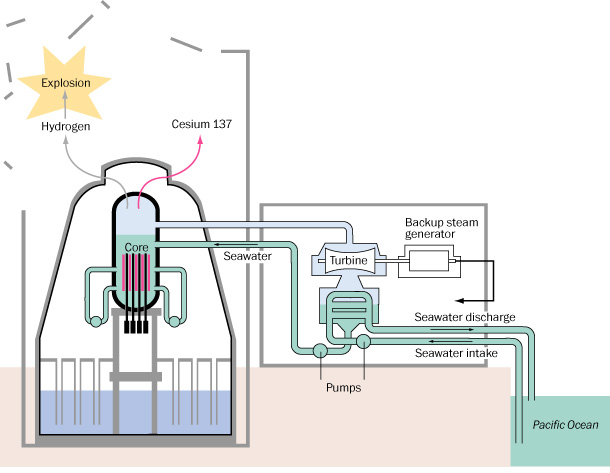 Radioactive Cesium 137 has been released into the environment, indicating core damage in at least one reactor.
The core in unit 1 heated up to the extent that some of of the zirconium cladding the fuel oxidized in water, releasing hydrogen gas. The gas was vented into the secondary containment building, where it combined with oxygen to create an explosion, blowing apart part of the secondary containment building. The primary containment vessel is reportedly intact.
In an effort to cool the core, engineers are flooding it with seawater doped with boron, which acts to dampen fission reactions.
Worst-case scenario
 Engineers need a restoration of power and adequate water supplies to contain damage to reactor cores. If, however, they are unable to cool a damaged core, uranium fuel could melt into a pool of radioactive lava, which might melt its way out of the reactor vessel and drain onto the floor of the primary containment vessel.
Nuclear analyst Kenneth D. Bergeron describes the primary containment vessels as "not particularly robust," better than Chernobyl, but not as good as Three Mile Island.
How bad is it?
RADIATION Japanese officials on Saturday said that radiation levels per hour at the site at one point were 1,000 times the amount an individual should be exposed to in a year - posing severe health risks to workers at close proximity. At least nine individuals in the area had already shown possible exposure to some of level radiation, and an official of Japan's nuclear safety agency said that number could rise to as high as 160.
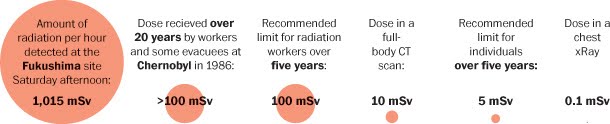
RADIOACTIVE ELEMENTS Thousands of cases of thyroid cancer were attributed to exposure to radioactive iodine in the food supply after the nuclear accident in Chernobyl, Ukraine in 1986. Cesium, which was also released at Chernobyl, increases the risk for other cancers. Japanese officials said that cesium and radioactive iodine had been detected near the site Saturday, and they have already begun distributing potassium iodide pills to block radioactive iodine from accumulating in people’s thyroid glands.

Evacuation
Authorities ordered an estimated 170,000 people to evacuate from a 20-kilometer (12.4-mile) radius around the Fukushima Daiichi plant and about 30,000 people to leave a 10-kilometer (6.2-mile) radius around the Fukushima Daini plant. The two plants are about seven miles away from each other.
Nuclear plants in seismic zones
Many nuclear reactors, like those in Japan, exist in earthquake-prone areas. More than 440 commercial nuclear reactors provide about 14 percent of the world’s electricity.

The four reactors in California are in two plants at San Clemente and near San Luis Obispo.
Iran’s new plant at Bushehr has been plagued by technical problems and delays and hasn’t begun production.
Pakistan has two reactors and a third is scheduled to open this year. So far only about 3 percent of its power comes from nuclear plants.

NOTE: Some reactors indicated above may not be in operation.
Japan’s 54 operating reactors provide nearly 30 percent of the country’s electricity.
 The March 11 earthquake led to the shutdown of the four nuclear power plants closest to the epicenter. Within a few hours, Japanese authorities ordered residents around the Daiichi plant to evacuate. They later extended the evacuation order to the nearby Daini plant, and declared a state of emergency for the two nuclear power complexes as military and utility officials scrambled to tame rising pressure and radioactivity levels inside the units and stabilize the systems used to cool the plants' hot reactor cores.
On Saturday afternoon, an explosion rocked the Daiichi plant, causing a portion of a building to crumble and sending white smoke billowing into the air.
SOURCES: Kenneth D. Bergeron, Training Centre for Nuclear Technology, International Nuclear Safety Center, Argonne National Laboratory, U.S. Dept of Energy, Global Seismic Hazard Assessment Program, United Nations Population Division.
GRAPHIC: Wilson Andrews, Bonnie Berkowitz, Patterson Clark, Laris Karklis, Alicia Parlapiano, Laura Stanton, Karen Yourish - The Washington Post. Published March 12, 2011.
Japan struggles with nuclear reactors in wake of quake

The Fukushima No. 1 power plant of Tokyo Electric Power Co.
By the CNN Wire Staff
March 12, 2011
Tokyo (CNN) -- Crews at a nuclear plant struck by an earthquake, then a tsunami and then an explosion in the span of 36 hours resorted Saturday to flooding a feverish nuclear reactor with sea water in hopes of preventing a meltdown of its core.
An explosion that sent white smoke rising above the Fukushima Daiichi plant Saturday afternoon buckled the walls of a concrete building that surrounded one of the plant's nuclear reactors, but did not damage the reactor itself, Chief Cabinet Secretary Yukio Edano told reporters.
The explosion was caused, he said, by a failure in a pumping system as workers tried to prevent the reactor's temperature from racing out of control.
While Edano said radiation levels appeared to be falling after the explosion, the government nevertheless ordered an expanded evacuation of the area around the Daiichi plant, as well as a second facility where the cooling system had failed -- the Fukushima Daini plant.
 On Saturday night, three patients at a hospital tested positive for radiation exposure, according to the Japanese public broadcasting station NHK, citing a statement from Fukushima Prefecture.
The three were randomly selected from a group of 90 hospital workers and patients who were already at the medical facility -- about three kilometers from the Daiichi plant -- before Friday's massive quake. The patients were outside of the hospital awaiting evacuation at the time of the explosion.
While the three showed signed of exposure, "no abnormal health conditions have been observed," NHK quoted the prefecture as saying.
Although government officials painted a hopeful picture, saying crews had begun implementing a backup plan to flood the reactor containment structure with sea water, a nuclear expert said the situation is dire even if it is already under control.
"If this accident stops right now it will already be one of the three worst accidents we have ever had at a nuclear power plant in the history of nuclear power," said Joseph Cirincione, an expert on nuclear materials and president of the U.S.-based Ploughshares Fund, a firm involved in security and peace funding.
If the effort to cool the nuclear fuel inside the reactor fails completely -- a scenario experts who have spoken to CNN say is unlikely -- the resulting release of radiation could cause enormous damage to the plant or release radiation into the atmosphere or water. That could lead to widespread cancer and other health problems, experts say.
 Tens of thousands of people live within the evacuation zone around the Daiichi plant, which authorities expanded to 20 kilometers (12.6 miles) from the earlier 10 kilometer radius following the explosion. More than 51,000 of those live within 10 kilometers, according to Japan's Nuclear and Industrial Safety Agency.
A total of more than 83,000 live within 10 kilometers of the two plants under evacuation orders, the agency said.
Figures for residents within the 20-kilometer zone were not immediately available.
Japanese authorities appeared to be preparing for the possibility of a nuclear release. Japan public broadcaster NHK reported the country's defense ministry had sent a unit that specializes in dealing with radioactive contamination to a command post near one of the stricken plants.
The government was also preparing to distribute iodine tablets to residents, the IAEA said. Iodine is commonly prescribed to help prevent the thyroid gland from taking in too much radioactivity, according to the U.S. Environmental Protection Agency website.
In all, the earthquake prompted the automatic shutdown of 10 reactors at three nuclear plants near the quake site, Japan's nuclear agency said. Problems have been reported at all three plants, although the fire reported Friday at the Onagawa nuclear plant was quickly extinguished and it has not been a focus of concern since.
At the Fukushima Daini plant, problems had been detected with the pressure and cooling systems at three of the four reactors that shut down, but plant owner Tokyo Electric Power Company reported all of the reactors were stable on Saturday.
Japan's nuclear agency said there is a strong possibility that the radioactive cesium the monitors detected was from the melting of a fuel rod at the plant, adding that engineers were cooling the fuel rods by pumping water around them. Cesium is a byproduct of the nuclear fission process that occurs in nuclear plants.
A spokesman for the agency said atomic material had seeped out of one of the five nuclear reactors at the Daiichi plant, located about 160 miles (260 kilometers) north of Tokyo.
The problems at the Fukushima Daiichi plant began with the 8.9-magnitude quake that struck Friday off the eastern shore of Miyagi Prefecture. The quake forced the automatic shutdown of the plant's nuclear reactors and knocked out the main cooling system, according to the country's nuclear agency.
A tsunami resulting from the quake then washed over the site, knocking out backup generators that pumped water into the reactor containment unit to keep the nuclear fuel cool, according to the agency.
As pressure and temperatures rose inside the reactors at the Daiichi and Daini plants, authorities ordered the release of valves at the plants -- a move that experts said was likely done to release growing pressure inside as high temperatures caused water to boil and produce excess steam.
As crews were working to pump additional water into the reactor containment unit to lower the temperature, the pumping system failed, Edano said, causing an explosion that injured four workers and brought down the walls of the building containing the reactor.
The team then reverted to a plan to flood the reactor with sea water, which Edano said would lower the temperature to acceptable levels. That work began Saturday night and was expected to take two days, Edano said.
Before Edano's announcement, Malcolm Grimston, associate fellow for energy, environment and development at London's Chatham House, said the explosion indicated that "it's clearly a serious situation, but that in itself does not necessarily mean major (nuclear) contamination."
"This is a situation that has the potential for a nuclear catastrophe. It's basically a race against time, because what has happened is that plant operators have not been able to cool down the core of at least two reactors," said Robert Alvarez, a senior scholar at the Institute for Policy Studies in Washington.
The situation ranks as the third-most-serious nuclear accident on record, Cirincione said. He said only the 1979 partial meltdown of a reactor core at the Three Mile Island nuclear plant in Pennsylvania and the 1986 Chernobyl disaster in the Soviet Union were worse.
If damage from the explosions or aftershocks have compromised the structural integrity of the reactor complex, it could make efforts to cool the reactors more difficult, Cirincione said.
 "The big unanswered question here is whether there's structural damage to this facility now," he said.
Janie Eudy told CNN that her 52-year-old husband, Joe, was working at the Fukushima Daini plant when the quake struck; he was injured by falling and shattering glass. As he and others were planning to evacuate, at their managers' orders, the tsunami struck and washed buildings from the nearby town past the plant.
"To me, it sounded like hell on earth," she said, adding that her husband -- a native of Pineville, Louisiana -- escaped.
Utility officials reported Saturday that more than 3 million households were without power, NHK said, and that power shortages may occur due to damage at the company's facilities.
"We kindly ask our customers to cooperate with us in reducing usage of power," Tokyo Electric Power Company said.
 Fukushima Daiichi plant |
The explosion was caused, he said, by a failure in a pumping system as workers tried to prevent the reactor's temperature from racing out of control.
While Edano said radiation levels appeared to be falling after the explosion, the government nevertheless ordered an expanded evacuation of the area around the Daiichi plant, as well as a second facility where the cooling system had failed -- the Fukushima Daini plant.
 On Saturday night, three patients at a hospital tested positive for radiation exposure, according to the Japanese public broadcasting station NHK, citing a statement from Fukushima Prefecture.
The three were randomly selected from a group of 90 hospital workers and patients who were already at the medical facility -- about three kilometers from the Daiichi plant -- before Friday's massive quake. The patients were outside of the hospital awaiting evacuation at the time of the explosion.
While the three showed signed of exposure, "no abnormal health conditions have been observed," NHK quoted the prefecture as saying.
Although government officials painted a hopeful picture, saying crews had begun implementing a backup plan to flood the reactor containment structure with sea water, a nuclear expert said the situation is dire even if it is already under control.
"If this accident stops right now it will already be one of the three worst accidents we have ever had at a nuclear power plant in the history of nuclear power," said Joseph Cirincione, an expert on nuclear materials and president of the U.S.-based Ploughshares Fund, a firm involved in security and peace funding.
If the effort to cool the nuclear fuel inside the reactor fails completely -- a scenario experts who have spoken to CNN say is unlikely -- the resulting release of radiation could cause enormous damage to the plant or release radiation into the atmosphere or water. That could lead to widespread cancer and other health problems, experts say.
 Tens of thousands of people live within the evacuation zone around the Daiichi plant, which authorities expanded to 20 kilometers (12.6 miles) from the earlier 10 kilometer radius following the explosion. More than 51,000 of those live within 10 kilometers, according to Japan's Nuclear and Industrial Safety Agency.
A total of more than 83,000 live within 10 kilometers of the two plants under evacuation orders, the agency said.
Figures for residents within the 20-kilometer zone were not immediately available.
Japanese authorities appeared to be preparing for the possibility of a nuclear release. Japan public broadcaster NHK reported the country's defense ministry had sent a unit that specializes in dealing with radioactive contamination to a command post near one of the stricken plants.
The government was also preparing to distribute iodine tablets to residents, the IAEA said. Iodine is commonly prescribed to help prevent the thyroid gland from taking in too much radioactivity, according to the U.S. Environmental Protection Agency website.
In all, the earthquake prompted the automatic shutdown of 10 reactors at three nuclear plants near the quake site, Japan's nuclear agency said. Problems have been reported at all three plants, although the fire reported Friday at the Onagawa nuclear plant was quickly extinguished and it has not been a focus of concern since.
At the Fukushima Daini plant, problems had been detected with the pressure and cooling systems at three of the four reactors that shut down, but plant owner Tokyo Electric Power Company reported all of the reactors were stable on Saturday.
Japan's nuclear agency said there is a strong possibility that the radioactive cesium the monitors detected was from the melting of a fuel rod at the plant, adding that engineers were cooling the fuel rods by pumping water around them. Cesium is a byproduct of the nuclear fission process that occurs in nuclear plants.
A spokesman for the agency said atomic material had seeped out of one of the five nuclear reactors at the Daiichi plant, located about 160 miles (260 kilometers) north of Tokyo.
The problems at the Fukushima Daiichi plant began with the 8.9-magnitude quake that struck Friday off the eastern shore of Miyagi Prefecture. The quake forced the automatic shutdown of the plant's nuclear reactors and knocked out the main cooling system, according to the country's nuclear agency.
A tsunami resulting from the quake then washed over the site, knocking out backup generators that pumped water into the reactor containment unit to keep the nuclear fuel cool, according to the agency.
As pressure and temperatures rose inside the reactors at the Daiichi and Daini plants, authorities ordered the release of valves at the plants -- a move that experts said was likely done to release growing pressure inside as high temperatures caused water to boil and produce excess steam.
As crews were working to pump additional water into the reactor containment unit to lower the temperature, the pumping system failed, Edano said, causing an explosion that injured four workers and brought down the walls of the building containing the reactor.
The team then reverted to a plan to flood the reactor with sea water, which Edano said would lower the temperature to acceptable levels. That work began Saturday night and was expected to take two days, Edano said.
Before Edano's announcement, Malcolm Grimston, associate fellow for energy, environment and development at London's Chatham House, said the explosion indicated that "it's clearly a serious situation, but that in itself does not necessarily mean major (nuclear) contamination."
"This is a situation that has the potential for a nuclear catastrophe. It's basically a race against time, because what has happened is that plant operators have not been able to cool down the core of at least two reactors," said Robert Alvarez, a senior scholar at the Institute for Policy Studies in Washington.
The situation ranks as the third-most-serious nuclear accident on record, Cirincione said. He said only the 1979 partial meltdown of a reactor core at the Three Mile Island nuclear plant in Pennsylvania and the 1986 Chernobyl disaster in the Soviet Union were worse.
If damage from the explosions or aftershocks have compromised the structural integrity of the reactor complex, it could make efforts to cool the reactors more difficult, Cirincione said.
 "The big unanswered question here is whether there's structural damage to this facility now," he said.
Janie Eudy told CNN that her 52-year-old husband, Joe, was working at the Fukushima Daini plant when the quake struck; he was injured by falling and shattering glass. As he and others were planning to evacuate, at their managers' orders, the tsunami struck and washed buildings from the nearby town past the plant.
"To me, it sounded like hell on earth," she said, adding that her husband -- a native of Pineville, Louisiana -- escaped.
Utility officials reported Saturday that more than 3 million households were without power, NHK said, and that power shortages may occur due to damage at the company's facilities.
"We kindly ask our customers to cooperate with us in reducing usage of power," Tokyo Electric Power Company said.
Friday, March 11, 2011
WikiLeaks suspect's treatment 'stupid,' U.S. official says
- PJ Crowley: Bradley Manning's treatment by US 'stupid'
The US treatment of the man accused of leaking secret cables to Wikileaks is "ridiculous and counterproductive and stupid", US state department spokesman PJ Crowley has said.
 Private First Class Manning is being held in solitary confinement in a military brig |
"Nonetheless Bradley Manning is in the right place," Mr Crowley said.
Private Manning is being held in solitary confinement at a maximum security US military jail.
He is shackled at all times and has been on suicide watch at the Quantico marine base in Virginia.
Mr Crowley was asked whether his comments were on the record and replied, "sure".
President Barack Obama was questioned about whether he agreed with Mr Crowley's comments at a news conference on Friday.
He responded by saying he had asked the Pentagon directly if the terms of Pte Manning's confinement were "appropriate" and received assurances that they were.
Mr Obama added that some aspects of Pte Manning's treatment "has to do with his safety as well".
Mr Crowley could not immediately be reached by the BBC on Friday, but one US report carried a quote from him saying he was speaking in a purely personal capacity, not representing the views of the US government.
'Elephant in room'
Philippa Thomas, a BBC journalist on a student fellowship in Boston, was among about two dozen people gathered to hear Mr Crowley talk about "the benefits of new media as it relates to foreign policy", at an event organised by the Center for Future Civic Media.
After a wide-ranging discussion, one young man said he wanted to address "the elephant in the room" and asked Mr Crowley what he thought about Wikileaks and, in his words, "torturing a prisoner in a military brig"?
Mr Crowley did not address the issue of torture, but replied that what was being done to Pte Manning by colleagues at the Department of Defence was "ridiculous and counterproductive and stupid".
"None the less Bradley Manning is in the right place," he added, going on to say that in Washington's view "there is sometimes a need for secrets… for diplomatic progress to be made".
Stripped
Amnesty International has described the treatment of Pte Manning, whose mother is Welsh, as "unnecessarily harsh and punitive" and has called on the British government to intervene.
In a letter released by his lawyers, Pte Manning claims he is routinely stripped each night and his prescription glasses are confiscated, leaving him with limited vision.
Military officials have said this is standard procedure for people deemed a suicide risk.
David House, a spokesman with the Bradley Manning Advocacy Fund, said it was clear there was "no justification for Bradley's inhumane treatment".
He went on: "I agree with Mr Crowley that it's just stupid and unproductive."
Pte Manning has been charged on 34 counts, including illegally obtaining 250,000 secret US government cables and 380,000 records related to the Iraq war from a military database.
He has also been charged with aiding the enemy, a capital offence, but prosecutors have said they will not seek the death penalty.
Subscribe to:
Posts (Atom)


