Saturday's explosion at the Fukushima Daiichi nuclear made leaking radiation, or even a meltdown, the primary threat facing a country just beginning to grasp the scale of devastation from the earthquake and tsunami.
Normal operation
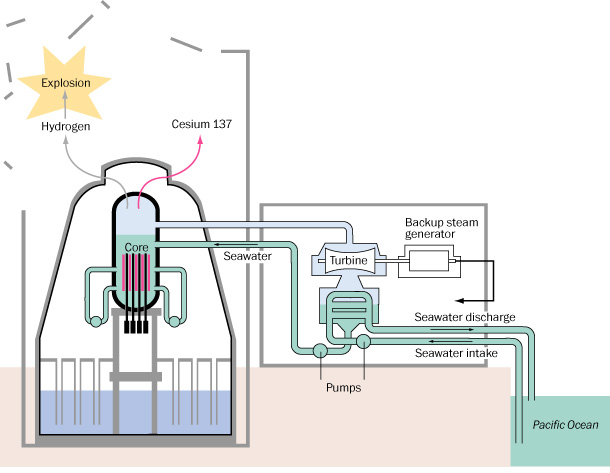
 In operation since the early 1970s, Japan’s Fukushima Daiichi nuclear plant uses six boiling water reactors, which rely on uranium nuclear fission to generate heat. Water surrounding the core boils into steam that drives turbines to generate electricity.
The reactor vessel is surrounded by a thick steel-and-concrete primary containment vessel, equipped with a water reservoir designed to suppress overheating of the vessel.
Seawater is pumped into a condensor that precipitates the steam into water, which is pumped back to the reactor.
Earthquake damage
 Friday’s disaster cut power to the system, and the tsunami disabled backup diesel generators. A third backup, turbines driven by steam from the reactor, generated electricity needed to run water through the reactor vessel. However, batteries used to control the operation of the reactor have been exhausted, but new diesel generators have been delivered.
Fuel rods in the core of reactor number 2 were reportedly exposed and at least partially out of water. Reactor number 1 reported leakage of reactor coolant and elevated radiation levels in the control room.
Control rods were inserted into the cores to stop fission, but cores need several days to cool down.
Damaged reactor
 Radioactive Cesium 137 has been released into the environment, indicating core damage in at least one reactor.
The core in unit 1 heated up to the extent that some of of the zirconium cladding the fuel oxidized in water, releasing hydrogen gas. The gas was vented into the secondary containment building, where it combined with oxygen to create an explosion, blowing apart part of the secondary containment building. The primary containment vessel is reportedly intact.
In an effort to cool the core, engineers are flooding it with seawater doped with boron, which acts to dampen fission reactions.
Worst-case scenario
 Engineers need a restoration of power and adequate water supplies to contain damage to reactor cores. If, however, they are unable to cool a damaged core, uranium fuel could melt into a pool of radioactive lava, which might melt its way out of the reactor vessel and drain onto the floor of the primary containment vessel.
Nuclear analyst Kenneth D. Bergeron describes the primary containment vessels as "not particularly robust," better than Chernobyl, but not as good as Three Mile Island.
How bad is it?
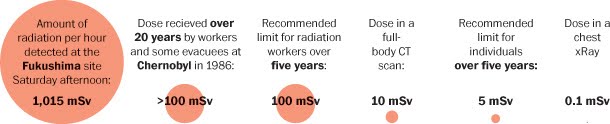
RADIATION Japanese officials on Saturday said that radiation levels per hour at the site at one point were 1,000 times the amount an individual should be exposed to in a year - posing severe health risks to workers at close proximity. At least nine individuals in the area had already shown possible exposure to some of level radiation, and an official of Japan's nuclear safety agency said that number could rise to as high as 160.

RADIOACTIVE ELEMENTS Thousands of cases of thyroid cancer were attributed to exposure to radioactive iodine in the food supply after the nuclear accident in Chernobyl, Ukraine in 1986. Cesium, which was also released at Chernobyl, increases the risk for other cancers. Japanese officials said that cesium and radioactive iodine had been detected near the site Saturday, and they have already begun distributing potassium iodide pills to block radioactive iodine from accumulating in people’s thyroid glands.

Evacuation
Authorities ordered an estimated 170,000 people to evacuate from a 20-kilometer (12.4-mile) radius around the Fukushima Daiichi plant and about 30,000 people to leave a 10-kilometer (6.2-mile) radius around the Fukushima Daini plant. The two plants are about seven miles away from each other.
Nuclear plants in seismic zones
Many nuclear reactors, like those in Japan, exist in earthquake-prone areas. More than 440 commercial nuclear reactors provide about 14 percent of the world’s electricity.

Nuclear reactors
The four reactors in California are in two plants at San Clemente and near San Luis Obispo.
Iran’s new plant at Bushehr has been plagued by technical problems and delays and hasn’t begun production.
Pakistan has two reactors and a third is scheduled to open this year. So far only about 3 percent of its power comes from nuclear plants.

NOTE: Some reactors indicated above may not be in operation.
Japan’s 54 operating reactors provide nearly 30 percent of the country’s electricity.
 The March 11 earthquake led to the shutdown of the four nuclear power plants closest to the epicenter. Within a few hours, Japanese authorities ordered residents around the Daiichi plant to evacuate. They later extended the evacuation order to the nearby Daini plant, and declared a state of emergency for the two nuclear power complexes as military and utility officials scrambled to tame rising pressure and radioactivity levels inside the units and stabilize the systems used to cool the plants' hot reactor cores.
On Saturday afternoon, an explosion rocked the Daiichi plant, causing a portion of a building to crumble and sending white smoke billowing into the air.
SOURCES: Kenneth D. Bergeron, Training Centre for Nuclear Technology, International Nuclear Safety Center, Argonne National Laboratory, U.S. Dept of Energy, Global Seismic Hazard Assessment Program, United Nations Population Division.
Normal operation
 In operation since the early 1970s, Japan’s Fukushima Daiichi nuclear plant uses six boiling water reactors, which rely on uranium nuclear fission to generate heat. Water surrounding the core boils into steam that drives turbines to generate electricity.
The reactor vessel is surrounded by a thick steel-and-concrete primary containment vessel, equipped with a water reservoir designed to suppress overheating of the vessel.
Seawater is pumped into a condensor that precipitates the steam into water, which is pumped back to the reactor.
Earthquake damage
 Friday’s disaster cut power to the system, and the tsunami disabled backup diesel generators. A third backup, turbines driven by steam from the reactor, generated electricity needed to run water through the reactor vessel. However, batteries used to control the operation of the reactor have been exhausted, but new diesel generators have been delivered.
Fuel rods in the core of reactor number 2 were reportedly exposed and at least partially out of water. Reactor number 1 reported leakage of reactor coolant and elevated radiation levels in the control room.
Control rods were inserted into the cores to stop fission, but cores need several days to cool down.
Damaged reactor
 Radioactive Cesium 137 has been released into the environment, indicating core damage in at least one reactor.
The core in unit 1 heated up to the extent that some of of the zirconium cladding the fuel oxidized in water, releasing hydrogen gas. The gas was vented into the secondary containment building, where it combined with oxygen to create an explosion, blowing apart part of the secondary containment building. The primary containment vessel is reportedly intact.
In an effort to cool the core, engineers are flooding it with seawater doped with boron, which acts to dampen fission reactions.
Worst-case scenario
 Engineers need a restoration of power and adequate water supplies to contain damage to reactor cores. If, however, they are unable to cool a damaged core, uranium fuel could melt into a pool of radioactive lava, which might melt its way out of the reactor vessel and drain onto the floor of the primary containment vessel.
Nuclear analyst Kenneth D. Bergeron describes the primary containment vessels as "not particularly robust," better than Chernobyl, but not as good as Three Mile Island.
How bad is it?
RADIATION Japanese officials on Saturday said that radiation levels per hour at the site at one point were 1,000 times the amount an individual should be exposed to in a year - posing severe health risks to workers at close proximity. At least nine individuals in the area had already shown possible exposure to some of level radiation, and an official of Japan's nuclear safety agency said that number could rise to as high as 160.
RADIOACTIVE ELEMENTS Thousands of cases of thyroid cancer were attributed to exposure to radioactive iodine in the food supply after the nuclear accident in Chernobyl, Ukraine in 1986. Cesium, which was also released at Chernobyl, increases the risk for other cancers. Japanese officials said that cesium and radioactive iodine had been detected near the site Saturday, and they have already begun distributing potassium iodide pills to block radioactive iodine from accumulating in people’s thyroid glands.

Evacuation
Authorities ordered an estimated 170,000 people to evacuate from a 20-kilometer (12.4-mile) radius around the Fukushima Daiichi plant and about 30,000 people to leave a 10-kilometer (6.2-mile) radius around the Fukushima Daini plant. The two plants are about seven miles away from each other.
Nuclear plants in seismic zones
Many nuclear reactors, like those in Japan, exist in earthquake-prone areas. More than 440 commercial nuclear reactors provide about 14 percent of the world’s electricity.

The four reactors in California are in two plants at San Clemente and near San Luis Obispo.
Iran’s new plant at Bushehr has been plagued by technical problems and delays and hasn’t begun production.
Pakistan has two reactors and a third is scheduled to open this year. So far only about 3 percent of its power comes from nuclear plants.

NOTE: Some reactors indicated above may not be in operation.
Japan’s 54 operating reactors provide nearly 30 percent of the country’s electricity.
 The March 11 earthquake led to the shutdown of the four nuclear power plants closest to the epicenter. Within a few hours, Japanese authorities ordered residents around the Daiichi plant to evacuate. They later extended the evacuation order to the nearby Daini plant, and declared a state of emergency for the two nuclear power complexes as military and utility officials scrambled to tame rising pressure and radioactivity levels inside the units and stabilize the systems used to cool the plants' hot reactor cores.
On Saturday afternoon, an explosion rocked the Daiichi plant, causing a portion of a building to crumble and sending white smoke billowing into the air.
SOURCES: Kenneth D. Bergeron, Training Centre for Nuclear Technology, International Nuclear Safety Center, Argonne National Laboratory, U.S. Dept of Energy, Global Seismic Hazard Assessment Program, United Nations Population Division.
GRAPHIC: Wilson Andrews, Bonnie Berkowitz, Patterson Clark, Laris Karklis, Alicia Parlapiano, Laura Stanton, Karen Yourish - The Washington Post. Published March 12, 2011.


