Monday, February 28, 2011

China floods Beijing with security before planned protest


By Jo Ling Kent, CNN
February 28, 2011

Beijing (CNN) -- For the second weekend in a row, anonymous calls by organizers for a pro-democracy demonstration in Beijing were overshadowed by heavy security presence.

Hundreds of Chinese police officers along with more than 120 vehicles flooded Beijing's central pedestrian shopping area, Wangfujing, around the site of a second attempted "jasmine" rally inspired by pro-democracy protests in Tunisia.

There was no sign of protest as the police deployed unusual tactics to prevent demonstrations.

At least three foreign press photographers at the scene were reportedly beaten by police officers and detained. Other foreign journalists, including CNN, were manhandled, detained and escorted away from the site.

At Beijing's Wangfujing shopping area, a large number of plainclothes and uniformed police officers circulated the area, which is typically known for being an open area attracting throngs of domestic and foreign tourists. Every entrance to the shopping area was guarded by multiple police officers on Sunday.

CNN crew detained by Beijing police

In front of a McDonald's restaurant, the appointed meeting place for demonstrators, a large construction site was erected several days ago following the first attempted demonstrations, directly blocking the open plaza outside the restaurant.

Nearby, a mysteriously large group of orange-clad street sweepers stood near the appointed protest area with brooms but did not sweep the street.

When protests were slated to begin, two large street-washing trucks began slowly driving through the main thoroughfare, blocking pedestrian traffic and spraying water. Plainclothes police sat in restaurants and storefront windows for hours, observing the surroundings, while uniformed police officers forced journalists and onlookers out of the vicinity.

In Hong Kong, approximately 25 concerned citizens who organized on Facebook gathered in the city center and carried placards and wore jasmine flower pins.

They gathered in front of the Golden Bauhinia, a statue of Hong Kong's official flower. It is a major tourist destination, especially for mainland Chinese tours.

Placards read, "Freedom and Democracy. End One Party Rule. Push for Political Reform."

One Hong Kong demonstrator, Lam Ng, called for the end of single-party governance. "I don't agree with the Chinese government," he said. "I don't like the corruption."

Meanwhile on Sunday morning, just hours before the demonstration was slated to begin, Chinese Premier Wen Jiabao participated in his third annual web chat with selected Internet users on Sunday, ahead of China's annual central leadership meeting and legislative session.

Among the 25,000 questions submitted were concerns for social stability. He presented several strategies to maintain calm including reducing the urban-rural income gap, increased benefits and opportunities for rural citizens, and eliminating corruption.

"I always say we should not only make the cake of social wealth as big as possible, but also distribute the cake in a fair way and let everyone enjoy the fruits of reform and opening up," Wen said Sunday morning.

He did not comment on the protests planned for last week or Sunday.

Efforts to organize an earlier protest on February 20 were deemed largely unsuccessful after casual observers and police outnumbered the few protesters that showed up for the demonstrations.

On Friday, anonymous instructions on a site on Facebook, which is blocked in China, encouraged people to show up at central locations in about two dozen major Chinese cities and "go for a walk" together on Sunday. Along with Facebook, Twitter and YouTube continue to be blocked, making calls for action available only to those outside mainland China or to Chinese who have access to virtual private networks with foreign IP addresses.

Meanwhile, LinkedIn, one of the last social networking sites allowed in the country, was temporarily blocked in China on Friday as the government ramped up internet censorship.

This time around, organizers tried to mask the events as "liang hui" -- a Mandarin term which commonly refers to meetings held each March by China's political leadership. The cleverly selected terminology is an attempt by protest organizers to circumvent censorship on popular microblogs in the lead-up to actual meetings held by the National People's Congress and Chinese People's Political Consultative Conference.

Words such as "jasmine" in Chinese and "Wangfujing" -- the famous Beijing shopping strip where Sunday's demonstrations are set to begin -- were not searchable on China's most popular microblog, Sina Weibo, on Friday. The Chinese name of U.S. Ambassador Jon Huntsman Jr. -- who showed up at last Sunday's "jasmine" protest in Beijing -- are also blocked.

When searching the terms, users see a message that states: "According to relevant laws and policies, search results cannot be shown."

Huntsman, wearing a black leather jacked with a patch of the American flag on his left shoulder, was captured at last week's protest in a widely viewed video posted on YouTube, in which he's called out by some in the crowd. One asks if he is "hoping China will become chaotic?" -- a reference to the unrest that has consumed several countries in Africa and the Middle East as protesters there demand democracy.

Speaking in Mandarin, Huntsman tells them that he "just came to have a look." The hecklers accuse him of pretending to not know about the protest and feigning ignorance.

U.S. Embassy spokesman Richard Buangan said Huntsman came upon the protests when he was passing through the area with his wife, two of his children and his son-in-law.

"Last Saturday, (members of) the Huntsman family were on their way to visit a Tiananmen Square museum, passing through Wangfujing Shopping district. The Huntsmans walking through Wangfujing, and the events that took place related to any so-called protests, were purely coincidental. Once the family realized a security-related situation was developing, they immediately left," Buangan said.

CNN's Jaime Florcruz and Licia Yee contributed to this report.

Gaddafi unflinching as rebel city fears counter-attack


People Power

Việt Nam hãy học bài học Tunisia, Egypt
Free the people, Free yourself

"Those who make peaceful revolution impossible,
make violence inevitable." - John F. Kennedy


Peaceful Revolution Hopeless
Non-violence Hopeless With Vietnam Communists


Tự do không phải ngồi đó mà có,
phải trả giá bằng sự quyết tâm, bằng xương, bằng máu ..
không phải van xin, thắp nến hiệp thông,
cầu nguyện chỉ có ở trong chùa chiền, nhà thờ.
teolangthang

****


Anti-government tribal rebels prepare for possible attacks by pro-Gaddafi loyalists
at a checkpoint in Ajdabiya area, 150 km (93.2 miles) southwest of Benghazi
February, 27, 2011.

By Maria Golovnina Maria Golovnina
TRIPOLI | Mon Feb 28, 2011


TRIPOLI (Reuters) – Libyan rebels awaited a counter-attack by Muammar Gaddafi's forces on Monday, after the country's leader defied demands that he quit to end the bloodiest of the Arab world's wave of uprisings.

Rebels holding Zawiyah, only 50 km (30 miles) west of Tripoli, said about 2,000 troops loyal to Gaddafi had surrounded the city.

"We will do our best to fight them off. They will attack soon," said a former police major who switched sides and joined the rebellion. "If we are fighting for freedom, we are ready to die for it."

Gaddafi is fighting a rebellion which has swept through his Mediterranean oil producing nation after uprisings toppled entrenched leaders in neighboring Tunisia and Egypt. His fierce crackdown has killed hundreds, triggering U.N. sanctions and Western condemnation, but has not turned the tide of protests.

Residents even in parts of the capital Tripoli have thrown up barricades against government forces. A general in the east of the country, where Gaddafi's power has evaporated, told Reuters his forces were ready to help rebels in the west.

"Our brothers in Tripoli say: "We are fine so far, we do not need help'. If they ask for help we are ready to move," said General Ahmed el-Gatrani, one of most senior figures in the mutinous army in Benghazi.

Analysts say they expect rebels eventually to take the capital and kill or capture Gaddafi, but add that he has the firepower to foment chaos or civil war -- a prospect he and his sons have warned of.

Monday looked likely to see nervousness in oil markets. NYMEX crude for April delivery was up $1.38 at $99.25 per barrel at 0722 GMT. Libya pumps only 2 percent of world oil and Saudi Arabia has boosted output, but traders fear turmoil intensifying in the Arab world.

Serbian television quoted Gaddafi as blaming foreigners and al Qaeda for the unrest and condemning the U.N. Security Council for imposing sanctions and ordering a war crimes inquiry.

"The people of Libya support me. Small groups of rebels are surrounded and will be dealt with," he said.

STAND DOWN CALLS

European powers said it was time for Gaddafi to stand down and Secretary of State Hillary Clinton said the United States was "reaching out" to opposition groups.

Residents of Zawiyah told of fierce fighting against pro-Gaddafi paramilitaries armed with heavy weapons.

"Gaddafi is crazy. His people shot at us using rocket-propelled grenades," said a man who gave his name as Mustafa. Another man called Chawki said: "We need justice. People are being killed. Gaddafi's people shot my nephew."

There were queues outside banks in Tripoli on Sunday for the 500 Libyan dinars ($400) the government had promised it would start distributing to each family.

From Misrata, a city 200 km (120 miles) east of Tripoli, residents said by phone a thrust by forces loyal to Gaddafi, operating from the airport, had been rebuffed with bloodshed.

But Libyan exile groups said later aircraft were firing on the city's radio station.

In the eastern city of Benghazi, opponents of the 68-year-old leader said they had formed a National Libyan Council to be the "face" of the revolution, but it was unclear who they represented.

They said they wanted no foreign intervention and had not made contact with foreign governments.

The "Network of Free Ulema," claiming to represent "some of Libya's most senior and most respected Muslim scholars," issued a statement urging "total rebellion" and endorsing the formation of an "interim government" announced two days ago.

FOREIGN WORKERS STRANDED

Western leaders, emboldened by evacuations that have brought home many of their citizens from the vast desert state, spoke out more clearly than before against Gaddafi.

"We have reached, I believe, a point of no return," Italy's Foreign Minister Franco Frattini said, adding it was "inevitable" that Gaddafi would leave power.

Britain revoked Gaddafi's diplomatic immunity and said it was freezing his family's assets. "It is time for Colonel Gaddafi to go," Foreign Secretary William Hague said.

Britain's former prime minister, Tony Blair, said he had spoken to Gaddafi on Friday and told him to go. Blair helped end the Western isolation of Gaddafi after he agreed to renounce weapons of mass destruction, paving the way for big British business deals in Libya.

Three British military planes evacuated 150 civilians from Libya's desert on Sunday, after a similar operation on Saturday.

Wealthy states have sent planes and ships to bring home expatriate workers but many more, from poorer countries, are stranded. Thousands of Egyptians streamed into Tunisia on Sunday, complaining Cairo had done nothing to help them.

Malta said it had refused a Libyan request to return two warplanes brought to the island by defecting pilots last Monday.

Gaddafi, once branded a "mad dog" by Washington for his support of militant groups worldwide, had been embraced by the West in recent years in return for renouncing some weapons programs and, critically, for opening up Libya's oilfields.

While money has flowed into Libya, many people, especially in the long-restive and oil-rich east, have seen little benefit and, inspired by the popular overthrow of veteran strongmen in neighboring Tunisia and Egypt, they rose up to demand better conditions and political freedoms.

(Additional reporting by Yvonne Bell and Chris Helgren in Tripoli, Marie-Louise Gumuchian and Souhail Karam in Rabat, Dina Zayed and Caroline Drees in Cairo, Tom Pfeiffer, Alexander Dziadosz and Mohammed Abbas in Benghazi, Arshad Mohammed in Washington and Louis Charbonneau at the United Nations; writing by Dominic Evans; editing by Tim Pearce)


Saturday, February 26, 2011

UN debates steps against Gaddafi


People Power

Việt Nam hãy học bài học Tunisia, Egypt
Free the people, Free yourself

"Those who make peaceful revolution impossible,
make violence inevitable." - John F. Kennedy


Peaceful Revolution Hopeless
Non-violence Hopeless With Vietnam Communists


Tự do không phải ngồi đó mà có,
phải trả giá bằng sự quyết tâm, bằng xương, bằng máu ..
không phải van xin, thắp nến hiệp thông,
cầu nguyện chỉ có ở trong chùa chiền, nhà thờ.
teolangthang

****
    Gaddafi must 'leave now': US President Barack Obama
From correspondents in Washington, AFP
February 27, 2011

PRESIDENT Barack Obama says that Libya's leader Muammar Gaddafi needs to "leave now," having lost the legitimacy to rule, a White House statement says.

Obama took the position - his most direct yet - in a telephone call with German Chancellor Angela Merkel, the statement said.

"The President stated that when a leader's only means of staying in power is to use mass violence against his own people, he has lost the legitimacy to rule and needs to do what is right for his country by leaving now," it said.

***
    Gaddafi in spotlight at UN Security Council
Source: http://www.bbc.co.uk/news/world-africa-12587078

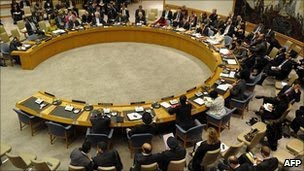
The UN Security Council is meeting to consider action against Colonel Muammar Gaddafi's government in Libya over its attempts to put down an uprising.

UN Secretary General Ban Ki-moon has
demanded "decisive action" from the
Security Council
A draft resolution calls for an arms embargo, travel ban and asset freeze.

It also proposes referring Col Gaddafi to the International Criminal Court for alleged crimes against humanity.

Meanwhile, one of Col Gaddafi's sons, Saif al-Islam, has insisted that normal life continues in three-quarters of Libya.

Anti-Gaddafi forces say they control 80% of the country, including the second city Benghazi, but the Libyan leader still controls the capital Tripoli, home to two million of the country's 6.5 million population.

The UN estimates more than 1,000 people have died in the 10-day-old revolt.

The global body's World Food Programme has warned that the food distribution system is "at risk of collapsing" in the North African nation, which is heavily dependent on imports.

UN Secretary General Ban Ki-moon has demanded "decisive action" over the Libya crisis by the Security Council. The draft resolution it is considering is backed by Britain, France, Germany and the US.

The Libyan delegation at the UN has sent a letter to the Security Council backing measures to hold to account those responsible for armed attacks on Libyan civilians, including action through the International Criminal Court.

The BBC's UN correspondent Barbara Plett says the main point of contention in the draft resolution is the proposal to refer Libya to the court, so the Libyan delegation statement will put pressure on those in the council who oppose the reference or want to water it down.

The US has already imposed sanctions against Libya, and closed its embassy in Tripoli.

President Barack Obama signed an executive order on Friday freezing assets held in the US by Col Gaddafi, members of his family and senior officials. The president said he was also seizing Libyan state property in the US, to prevent it being misappropriated by Tripoli.

Thousands of foreign nationals - many of them employed in the oil industry - continue to be evacuated from the country by air, sea and land.

Saturday saw two British military transport aircraft pick up about 150 foreign nationals in the desert south of the second city, Benghazi, and fly them to the Mediterranean island of Malta.

Britain also announced it had temporarily closed its embassy in Tripoli and pulled out its staff on the last UK government-chartered aircraft because of the deteriorating security situation.

Airport chaos

BBC Middle East editor Jeremy Bowen, at Tripoli airport, reports that about 10,000 people remain outside the terminal building and several thousand more are inside. He saw piles of discarded luggage and personal possessions, even TVs, abandoned by people who've been desperate to get out.

Most of the people trying to leave are Egyptians, and many of them told our correspondent they had been waiting there for seven days.

Friday saw Col Gaddafi make a defiant address to supporters in Tripoli, while on Saturday the al-Arabiya TV network broadcast an interview with his son, Saif al-Islam.

"What the Libyan nation is going through has opened the door to all options, and now the signs of civil war and foreign interference have started," said Saif Gaddafi.

"An agreement has to be reached because the people have no future unless they agree together on a new programme."

Friday saw reports of anti-government demonstrators in several areas of Tripoli coming under fire from government troops and pro-Gaddafi militiamen, but on Saturday the capital city was calm, with shops open and people on the streets.

A Libyan journalist told the BBC that supporters of Colonel Gaddafi were occupying central Green Square in a public show of support.

Outside the capital, anti-Gaddafi protesters are consolidating their power in Benghazi. Leaders of the uprising are setting up committees to run the city and deliver basic services.

It is believed that rebels are fighting units of the regular army in the western cities of Misrata and Zawiya.
***
    Australia imposes sanctions on Libya
AAP, February 27, 2011

AUSTRALIA has imposed its first sanctions on Libya, placing a travel ban and an arms embargo on Muammar Gaddafi and his close circle of cronies.

It means Gaddafi, members of his family and the regime's senior military and security personnel are prohibited from entering or transiting in Australia.

Foreign Minister Kevin Rudd, currently in Cairo, said Gaddafi and his entourage are also banned from engaging in financial transactions with Australians.

It comes after the bloody authoritarian response to the civil uprising in Libya and no sign that Gaddafi is willing to relinquish his decades-long dictatorship.

"The Libyan regime's use of violence against its people is deeply disturbing and completely unacceptable" Mr Rudd said in a statement today.

"The time has come for Australia to reflect its grave concern by enacting these practical measures."

Mr Rudd also urged the UN Security Council to begin sanctions against the Libyan regime and to refer violence in the country to the International Criminal Court.

The US has also imposed sanctions on Libya.


Friday, February 25, 2011

UN chief urges action over Libya


People Power

Việt Nam hãy học bài học Tunisia, Egypt
Free the people, Free yourself

"Those who make peaceful revolution impossible,
make violence inevitable." - John F. Kennedy


Peaceful Revolution Hopeless
Non-violence Hopeless With Vietnam Communists


Tự do không phải ngồi đó mà có,
phải trả giá bằng sự quyết tâm, bằng xương, bằng máu ..
không phải van xin, thắp nến hiệp thông,
cầu nguyện chỉ có ở trong chùa chiền, nhà thờ.
teolangthang

****

Click to play

>


The BBC's Jeremy Bowen reporting from Tripoli says the uprising is spreading

Source: http://www.bbc.co.uk/news/world-africa-12585949

United Nations Secretary General Ban Ki-moon has urged the global body's Security Council to take "decisive action" over the Libya crisis.

He said violations of human rights had been carried out by Muammar Gaddafi's regime, and more than 1,000 had died.

Speaking at a meeting of the Security Council in New York, Mr Ban warned of a growing refugee and food crisis.

In Libya, reports say anti-government protesters in the capital Tripoli came under heavy gunfire on Friday.

Witnesses reported deaths and injuries as militiamen and government troops confronted protesters as they emerged from mosques following Friday prayers and started demonstrating in several areas of the city.

At the same time, Libyan state TV showed Colonel Gaddafi speaking from the Tripoli's old city ramparts, urging the crowd to arm themselves and defend the nation and its oil against the anti-Gaddafi elements who have taken control of large parts of the country.

"We shall destroy any aggression with popular will," he said. "With the armed people, when necessary we will open the weapons depots. So that all the Libyan people, all the Libyan tribes can be armed. Libya will become a red flame, a burning coal."

Later, at a hastily organised news conference at the UN in New York, Libyan deputy ambassador Ibrahim Dabbashi described Col Gaddafi, who has been in power for 42 years, as a "madman". He warned that thousands would die in Tripoli because the Libyan leader would never flee and would fight to the end.

Much of the east of the country is in the hands of anti-Gaddafi protesters and units of the Libyan military that have crossed over to them.

Mr Ban said 22,000 people had fled Libya via Tunisia, and a further 15,000 via Egypt.

"Much larger numbers are trapped and unable to leave," he added. "There are widespread reports of refugees being harassed and threatened with guns and knives."

He said it was important for neighbouring countries, including those in Europe, to keep their borders open to those fleeing the violence.

Mr Ban also said that there was a food crisis inside Libya that the UN World Food Programme (WFP) expected to worsen. The WFP says Libya's food supply chain is at risk of collapse because imports have not been getting into the country and food distribution is hampered by violence.

Diplomats at the UN Security Council say Britain and France have drawn up a draft resolution with a package of measures aimed at isolating Libya's political and military leaders. Elements could include targeted sanctions, an arms embargo, and a proposed referral of the situation in Libya to the International Criminal Court.
'Exaggerated media campaign'

The BBC's Middle East editor Jeremy Bowen has entered the Libyan capital at the invitation of the Libyan government.

Saif al-Islam Gaddafi, son of the Libyan leader, told him that the reports of extreme violence were an "exaggerated media campaign" run by "hostile Arab TV channels".

It was not true that Libya had bombed civilians, Mr Gaddafi said, although he did say that the air force had bombed ammunition dumps that were in enemy hands.

Visitors to Tripoli would not hear gunfire but might hear fireworks, Mr Gaddafi said. He criticised the protesters, some of whom wanted an Islamic "Afghan solution" to the country's problems.

He admitted that the east of Libya was "a big mess". People were behind his father, Mr Gaddafi said, and would come out into the streets to support him.

White House spokesman Jay Carney said the Obama administration was acting "to put pressure on the regime" to cease the violence. "Colonel Gaddafi has lost the confidence of his people," he added.

Evacuations of foreign nationals from Libya by sea continued on Friday:

  • A US-chartered ferry carrying Americans evacuated from Libya arrived in Malta on Friday evening
  • Britain has sent a second ship, the destroyer HMS York, to deploy to the sea area near Libya; the frigate HMS Cumberland has picked up more than 200 people and is taking them to Malta
  • India is sending warships to the region to evacuate its nationals
Hundreds of sub-Saharan Africans are said to be fleeing southern Libya into Niger. Many more are stranded in Libya, where they say they are being attacked by people accusing them of being mercenaries fighting for Col Gaddafi.